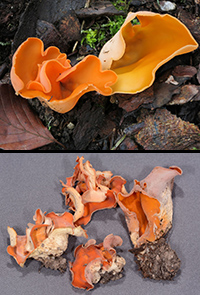
Fungi
The mycological collection of the United Herbaria Z+ZT is kept separately in the ‘Fungarium’ located in the CHN building of the ETH center. The Fungarium houses an estimated 1 million of dried specimens and covers all groups of fungi, lichens and fungus-like organisms.
All fungal groups are well represented, but the collection focuses on certain groups of basidiomycetes (rust fungi, southern hemisphere representatives of Agaricales and Boletales), ascomycetes, and, more recently, Glomeromycota.
Past digitization efforts have focused on plant pathogenic fungi of which the Fungarium holds approximately 100’000 specimens and 2’500 types. Current research and digitization focus on the important type holdings of the Fungarium across all fungal groups, with a specific focus on conservation relevant macromycetes.
The digitized holdings of the Fungarium are accessible on NAHIMA, the database of the natural history collections of the ETH Zurich.
Curator of fungi and lichens: Dr. Artemis Treindl
Important collections:
Eduard Fischer (1861-1939) (formerly BERN): plant parasitic fungi, mainly from Switzerland; Ernst Gäumann (1893-1963): plant parasitic fungi, especially rust fungi, mainly from Switzerland and Europe; Eugène Mayor (1877-1976): plant parasitic fungi from Switzerland, Europe, South America; Reinhard Berndt (1960-): rust fungi, globally with specific focus on neotropics and South Africa; Emil Müller (1920-2008): Ascomycetes, mainly Switzerland and Europe; Egon Horak (1937-): Agaricales and Boletales, mainly southern hemisphere, arctic-alpine fungi; Beatrice Senn-Irlet (1954-): Basidiomycetes, mainly Switzerland and Europe; Edwin Schild(1927-2014): European coral-fungi, especially Ramaria s. l.; Ernst Stizenberger (1827-1895): Lichens, including from South Africa.
The Fungarium continues to grow mainly by donations from Swiss mycologists, scientific institutions or collecting expeditions.
The Fungarium continues to grow mainly by donations from Swiss mycologists, scientific institutions or collecting expeditions.